Showing posts with label Study abroad. Show all posts

Tuesday, 30 May 2017

Fiesole


When the heat of Florence gets too much it's nice to be able to escape to the surrounding hills.  Walking up to Piazza San Marco if you wait and catch the number 7 bus for a mere 1 euro 20 (2.40 return) you'll be whisked up into the surrounding green of Fiesole in a matter of minutes (I've put what will hopefully be a useful photo of the timetable below). The small village is famous for its incredible Roman ruins and beautiful views over the city.

It's also famous for being at the heart of E.M. Forster's A Room with a View (one of the most famous books to be set in Florence) as it's near Fiesole where the protagonist Lucy Honeychurch is kissed by George Emerson in a poppy and barley field overlooking Florence. It's also mentioned in one of the first pieces of wisdom she's offered when she arrives in Florence by Mr. Beebe:
“Don’t neglect the country round,” his advice concluded. “The first fine afternoon drive up to Fiesole, and round by Settignano, or something of that sort.” 
I'm ashamed to think that I'm encouraging you to become the very people that Mr. Eager despises (who seems like the voice of Forster himself here):
Sometimes as I take tea in their beautiful grounds I hear, over the wall, the electric tram squealing up the new road with its loads of hot, dusty, unintelligent tourists who are going to ‘do’ Fiesole in an hour in order that they may say they have been there, and I think—think—I think how little they think what lies so near them.
However I have confidence you'll want to visit Fiesole again, and linger for far longer than an hour, and with the bus there's really no excuse to not head up to the hills once every now and then. I'm determined to explore further afield. Forster describes the countryside and ruins around Fiesole beautifully:
A hollow like a great amphitheatre, full of terraced steps and misty olives, now lay between them and the heights of Fiesole, and the road, still following its curve, was about to sweep on to a promontory which stood out in the plain.
These photos were taken from the small memorial garden on the way up the hill to the magical San Francesco Monastery. If this view is the 'hackneyed view' that is discarded by Mr. Eager then I'm certainly eager to see what the other hills around Florence hold in store! 
I am about to venture a suggestion. Would you and Miss Honeychurch be disposed to join me in a drive some day this week—a drive in the hills? We might go up by Fiesole and back by Settignano. There is a point on that road where we could get down and have an hour’s ramble on the hillside. The view thence of Florence is most beautiful—far better than the hackneyed view of Fiesole. 


For those attempting to take the bus here's the timetable:


SaveSaveSaveSave
SaveSave

Friday, 19 May 2017

Renaissance Tapestries and Textiles Diplomacy


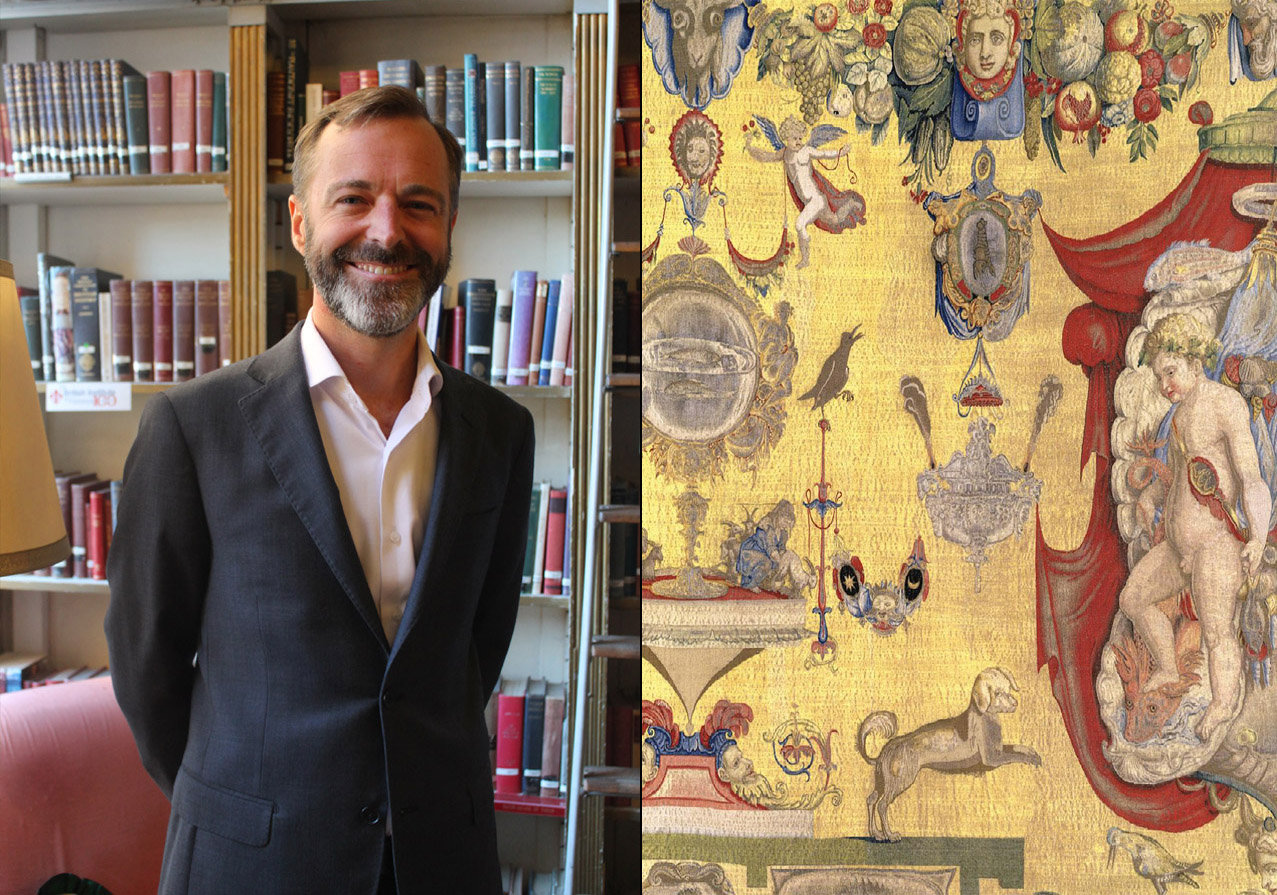
In London earlier this year Professor Jeremy Boudreau, the director of the British Institute's History of Art department, gave the inaugural Harold Acton lecture at the Italian Embassy, on "Renaissance Tapestries and Textiles Diplomacy" examining the Medici family's collection of Italian Spalliere tapestries, which are currently on loan from the Palazzo Pitti Museum and on show in the Breakfast Room of the Italian Embassy. 

Lucky for us Professor Bourdeau was kind enough to give The British Institute a ‘backwards view’ of the talk from a Florentine perspective. He unravelled the important collection of rarely displayed tapestries for us, explaining their political and economic significance in the time of the Medicis, proving once and for all that there’s more to the tapestry tradition than just a pretty covering.


In 1545 Cosimo Medici set up the first examples of tapestry workshops using Flemish weavers as a ‘start up’ of sorts to teach their trade to Florentine artists. Cosimo was cunning, rather than simply importing the skill of foreign hands he invested the time and the energy to ensure the creation of a ‘local’ art form by providing the basis for trade to be adopted and artisans to learn and practice their skills within the city. 

Not only this but Cosimo ensured motivation for his artisans, establishing two rival workshops at the same time. One was led by Jan Roost and the other by Nicolas Karcher, the first patronised by the Duke of Ferrara and the second by the Duke of Mantova. The healthy competition of the two workshops within the city is undoubtedly one of the reasons they tirelessly produced some of the most spectacular tapestries we have to date. 

The State dining room with the Medicean Spalliere Tapestries. Image by Federico Zonno.

Bourdeau’s keen academic eye is inspiring. He takes us through overarching themes, explaining the traditional techniques of tapestries and the scenes of grotesques, the cherubs, garlands and festoons of flowers, species of birds, fish and other animals, the fantastical creatures intertwined with luscious foliage as well as the Spalliere (Tuscan 15th and early 16th century painted wall panels and hangings) of the time. He also draws our attention to minute details on the tapestries that reveal their changing identity in the Florentine realm, inscriptions such as ‘FATTO – IN - FIORENZA’, an early 'Made in Florence' or ‘Made in Italy’ if you will. Another example that crops up is SPQF a play on SPQR, the initialism used by the Roman Senate and People, small but potent symbols of the growing pride felt in Florence for their adopted Flemish art.

Yet context with these artworks is key and Bourdeau made sure to guide us into the two rooms in the Palazzo Vecchio that the site-specific tapestries were originally designed for, Sala dei Dugento and the Sala dell’Udienza. The wall coverings truly clothe the rooms, leaving not a spot untouched by gold and vivid colours from floor to ceiling. Only last year saw the newly restored Sala dei Dugento and its vivid depictions of Joseph ‘the prince of dreams’ open to the public for a special exhibition. We can only hope after its success that more such public reunions of the tapestries with their settings will follow. 

The Sistine Chapel and Tapestries

When looking at the elaborate weavings it's easy to realise how Florence was being reinvented by the Medici. Under Cosimo it was rapidly becoming a centre for tapestry production but the artwork was also introducing a new vocabulary for Renaissance paintings from the ‘cartoons’ the Flemish weavers used as drafts to transform into tapestries. In fact many ‘cartoons’ themselves stand alone now as artworks recognised in their own right (several in London’s V&A museum). 

Tapestries were a means of displaying a story as well as boasting about one’s wealth. In Rome Boudreau highlighted perhaps the most famous example of the Sistine Chapel. Here tapestries were originally paired with the paintings (as if they weren’t decorative enough!) and designed to hang under the ornate scenes on the walls depicting Raphael’s Acts of the Apostles (1515-1520) woven in silk and wool with silver-gilt threads. It seems absurd that another layer of opulence could be added to such a treasure chest of a Chapel, yet excess seems to have been all part of the game.

Jan Rost and Nicolas Karcher, Spalliere with grotesques based on cartoons by Bachiacca (1545), Silk, gold, silver and wool tapestry, Italian Embassy London
Boudreau amusingly recalled the comments of the Bishop of Winchester, Stephen Gardiner, who was shocked after visiting the Pontiff exiled in Orvieto declaring that “Before reaching his [Pope Clement VII] chamber we passed three chambers all naked and unhanged.” When even the Pope lacked the grandeur of ‘clothed’ walls, one knew something was up. 

Intriguingly although based on Italian cartoons and designs many tapestries of the time were still produced in Brussels and outside of Italy. It was mainly through the persistence of Cosimo that Italian weavers were eventually able to take over from their original Flemish masters. 

One of the most interesting moments of the evening came towards the end of the talk where Boudreau attempted to put the young Cosimo’s rule in context with the other leaders of the time. He jokingly observed how he must have had a rather bad ‘inferiority complex’, flashing up images of Henry VIII, Charles V, Paul III and Frances I, it’s easy to see why. Meeting and surpassing the expectations of political visitors was paramount, dazzling, distracting and even intimidating guests with the beauty of ornate tapestries was all part and parcel of playing the part. 

Although we weren’t able to head down to the State dining room to observe the tapestries first hand as the original audience at the Italian embassy were after the talk, the lecture was still a truly immersive experience. Julia Race, the Institute’s director, described the experience as akin to walking with Bourdeau through the Palazzo Vecchio, and it’s true – he led us by the hand.


SaveSave

Thursday, 4 May 2017

Back to School


A week has already flown by, so I thought it was about time I show you where I spend most of my mornings here in Florence, the language school! As well as the famous Harold Acton Library the British Institute own another space for their famous language centre which is based on the north side of the Arno in the beautiful Piazza Strozzi, just a quick stroll across Ponte Santa Trinita and through Via de Tornabuoni and Via Porta Rossa (both streets studded with every exciting designer shop you can imagine). Handily it's got the wonderful Odeon bistro coffee shop based just below it and the famous Cinema Odeon Firenze right around the corner, so right in the thick of things while still just outside of the main tourist trails. The long corridors are lined with gorgeous art works, an assortment of comfortable chairs and a couple of very welcome vending machines. 

Every morning just before 10am I climb the many flights of stairs up to the last floor (there is a lift but I figure it's good practice to counter the vast quantities of delicious pasta I'm consuming). Here, usually in room 11, I study with my fellow Beginners till 12:45 (with a coffee break – ovviamente!). There are quite a lot of us at the institute this spring term, so we're divided into groups, for us there's Group 1 and Group 2, with everyone from a Hungarian banker, gap year and university students, post-university students, writers, musicians and nursing assistants. A wonderful mix of people from all walks of life who are all just as excited to be in Florence learning Italian. Perfetto! 


SaveSave